Apply
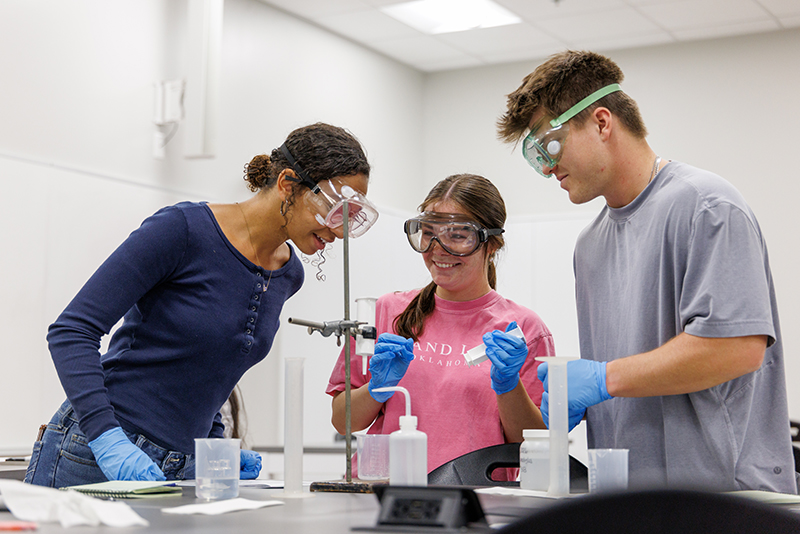
Three students wearing safety goggles and blue gloves conduct a laboratory experiment, gathered around a lab bench with graduated cylinders, beakers and measuring equipment. One student holds a sample while the group observes and discusses the procedure in a bright classroom laboratory setting.

What is environmental policy?

Environmental policy connects science with the decisions and regulations that shape how natural resources are managed. The environmental policy option combines environmental science with coursework in policy, economics, communication and the social sciences. Students learn to evaluate environmental issues, understand regulatory processes and communicate scientific information to diverse audiences, preparing them for careers at the intersection of science, policy and environmental decision-making.

Why environmental policy?

If you’re interested in environmental issues and want to understand how science informs policy and decision-making, the environmental policy option offers a flexible path to a variety of careers. Graduates are prepared for roles in government, environmental consulting, sustainability, planning, compliance, environmental health and safety, and nonprofit organizations. The program also provides a strong foundation for graduate study, including environmental law and related fields.

Career paths

Employment for graduates occurs in a wide range of fields and sectors. Our graduates can look forward to a career in one or more of the following fields:

100% CAREER PREPARATION

Every OSU environmental science student builds professional experience and career-ready skills through sampling and analysis courses, internships and a capstone experience.

Highlights

Hands-on learning

Environmental policy comes to life when science is applied to real-world decisions. Through coursework, internships and the senior capstone project, students gain experience evaluating environmental issues, working with stakeholders, and considering the scientific, economic, regulatory and social factors that influence environmental decisions.

Where science meets policy

Environmental decisions require an understanding of both science and people. The environmental policy option combines environmental science with policy, economics, communication and the social sciences, preparing students to understand how environmental laws and regulations are developed and applied. This broad perspective is valuable for careers in government, environmental health and safety, consulting, compliance, sustainability and policy, as well as preparation for environmental law.

Undergraduate research

Environmental policy students can work with faculty across the Ferguson College of Agriculture and beyond on research addressing the many dimensions of environmental challenges. Undergraduate research provides opportunities to explore topics such as environmental policy and decision-making, natural resource management, sustainability, environmental quality and human dimensions while developing skills in research, analysis and communication. These experiences can also help students determine whether graduate or professional study is the right next step.